Why visit Tiwanaku
Why visit Tiwanaku
The Andes' great capital before the Inca
Centuries before the Inca rose, Tiwanaku was one of the most important cities in the Andes — the ceremonial and political heart of a civilisation that spread its influence across the southern altiplano. At its height, roughly AD 375–700, it drew people and tribute from across the region. Standing among its temples, you're at one of the deepest roots of Andean civilisation.
Stonework that still puzzles
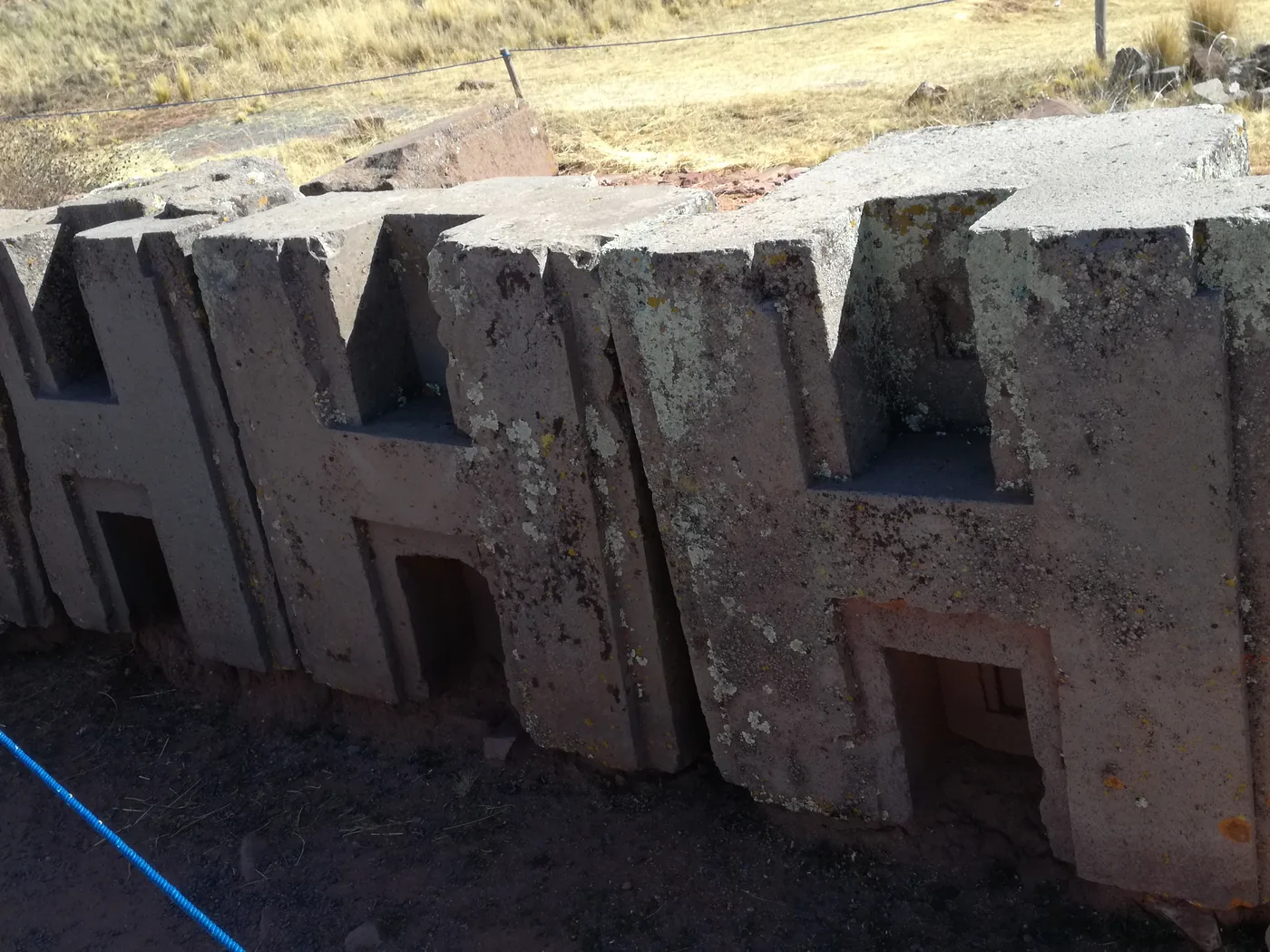
Tiwanaku is famous for the precision of its stone. At Puma Punku, massive andesite and sandstone blocks — the largest weighing an estimated 131 tonnes — were cut with flat faces, sharp interior angles and interlocking joints so exact they still astonish visitors and engineers alike. It is some of the most remarkable ancient masonry in the Americas.
A monumental site on the roof of the world
The ruins sit on the open altiplano at around 3,850 metres, near Lake Titicaca, under an enormous sky. The Gateway of the Sun, the raised Kalasasaya court, the Akapana platform and the great carved monoliths make for a stark, powerful landscape — and two on-site museums hold the finest carvings and finds.
What to see at Tiwanaku
What to see at Tiwanaku
Tiwanaku is a walk across a monumental ceremonial city on the altiplano. These are the things to look for as you go.
- Gateway of the Sun
La Puerta del Sol
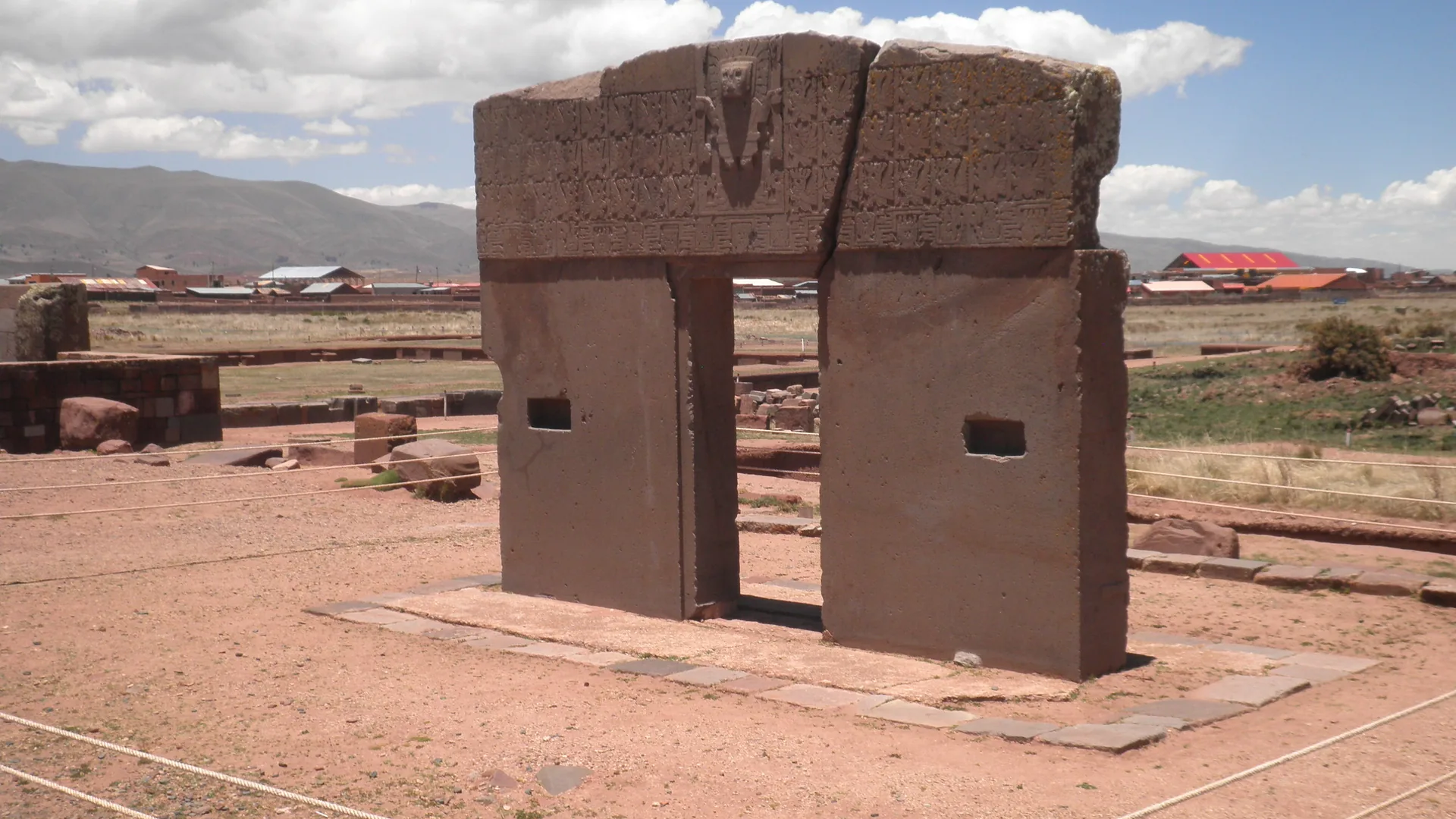
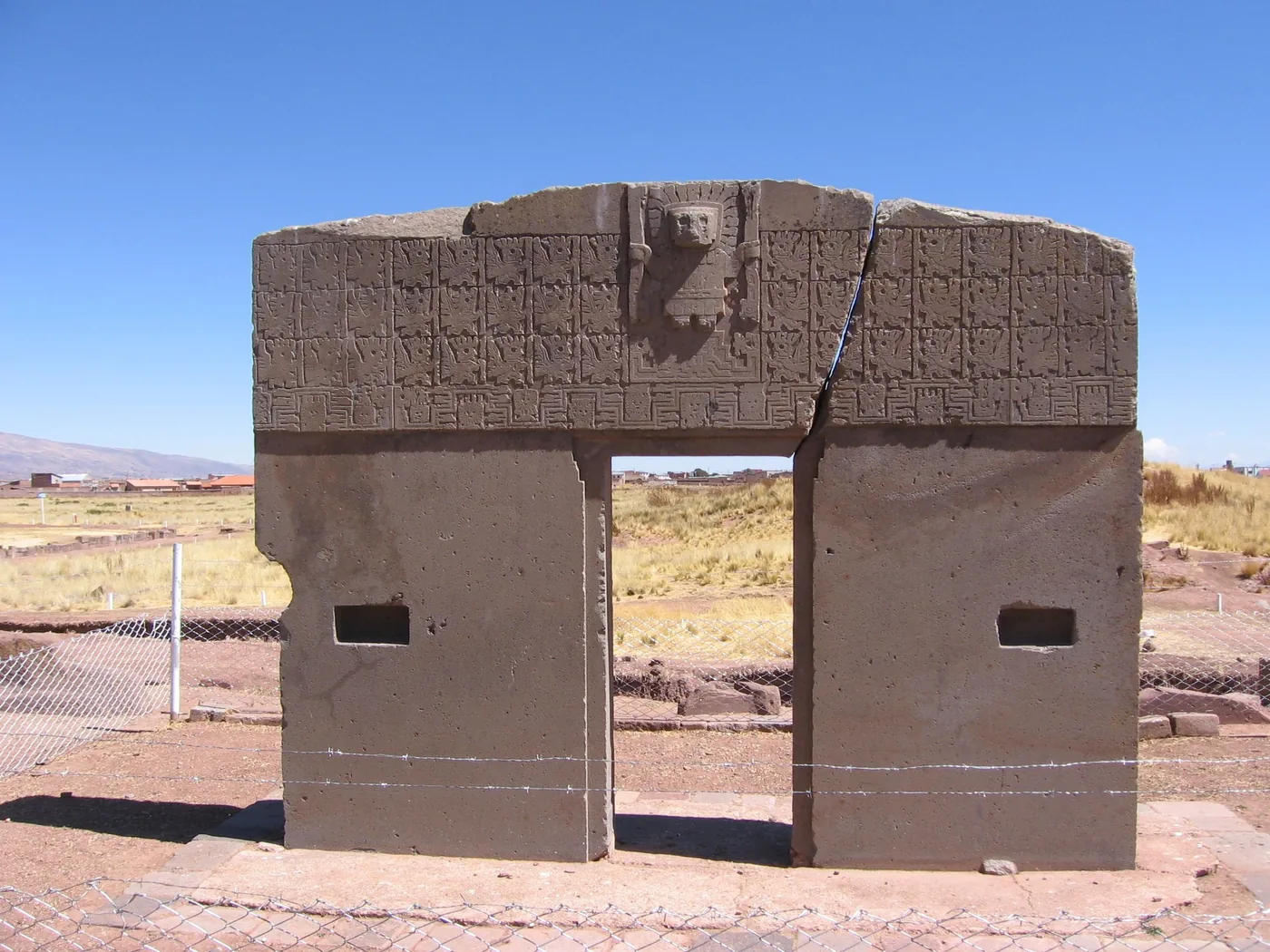
Tiwanaku's most famous monument: a single great arch carved from one block of andesite, its lintel cut with a central figure — often read as a sun or staff god — flanked by rows of winged attendants. It is the enduring image of the site.
- Kalasasaya
The great raised court
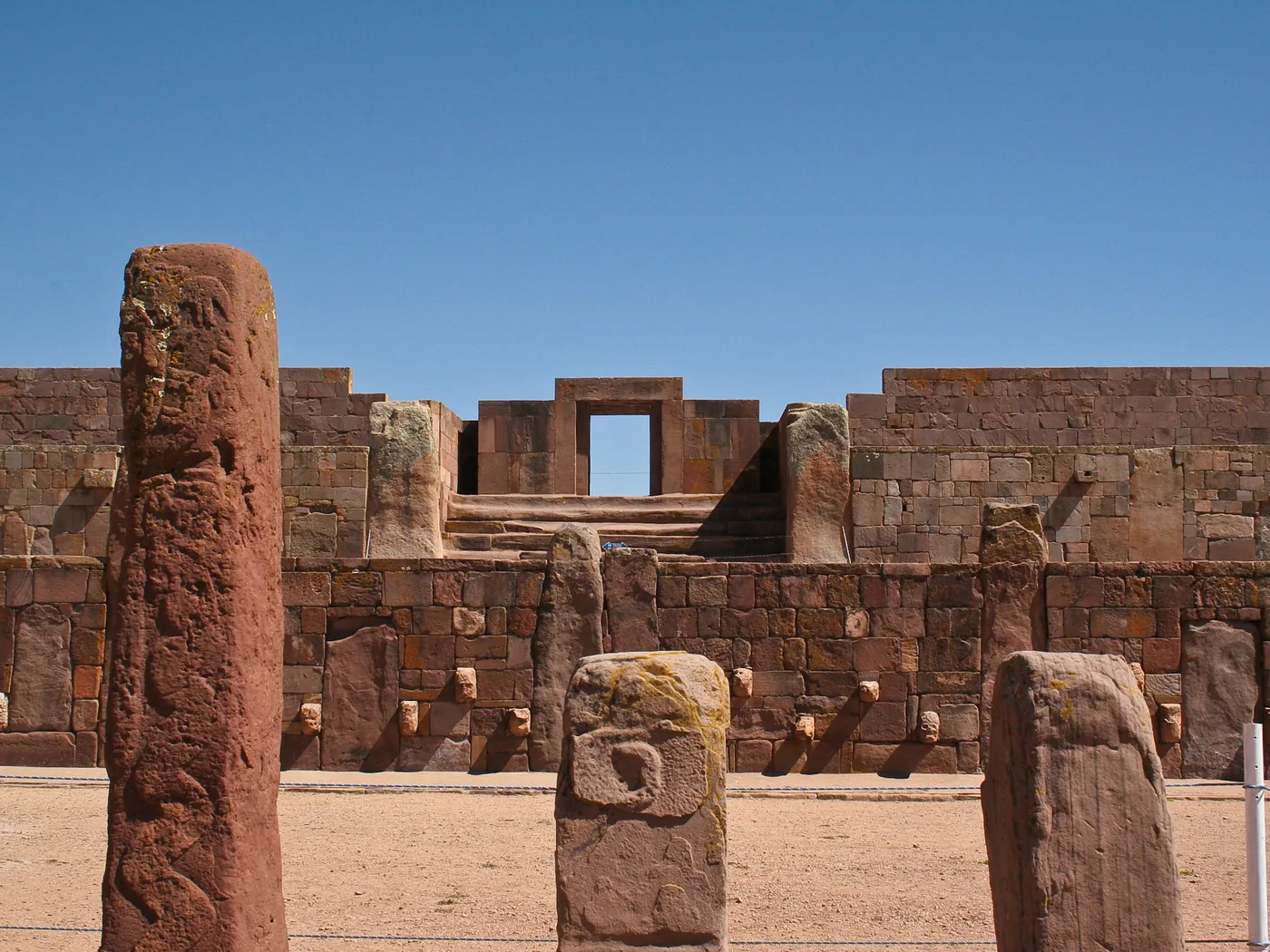
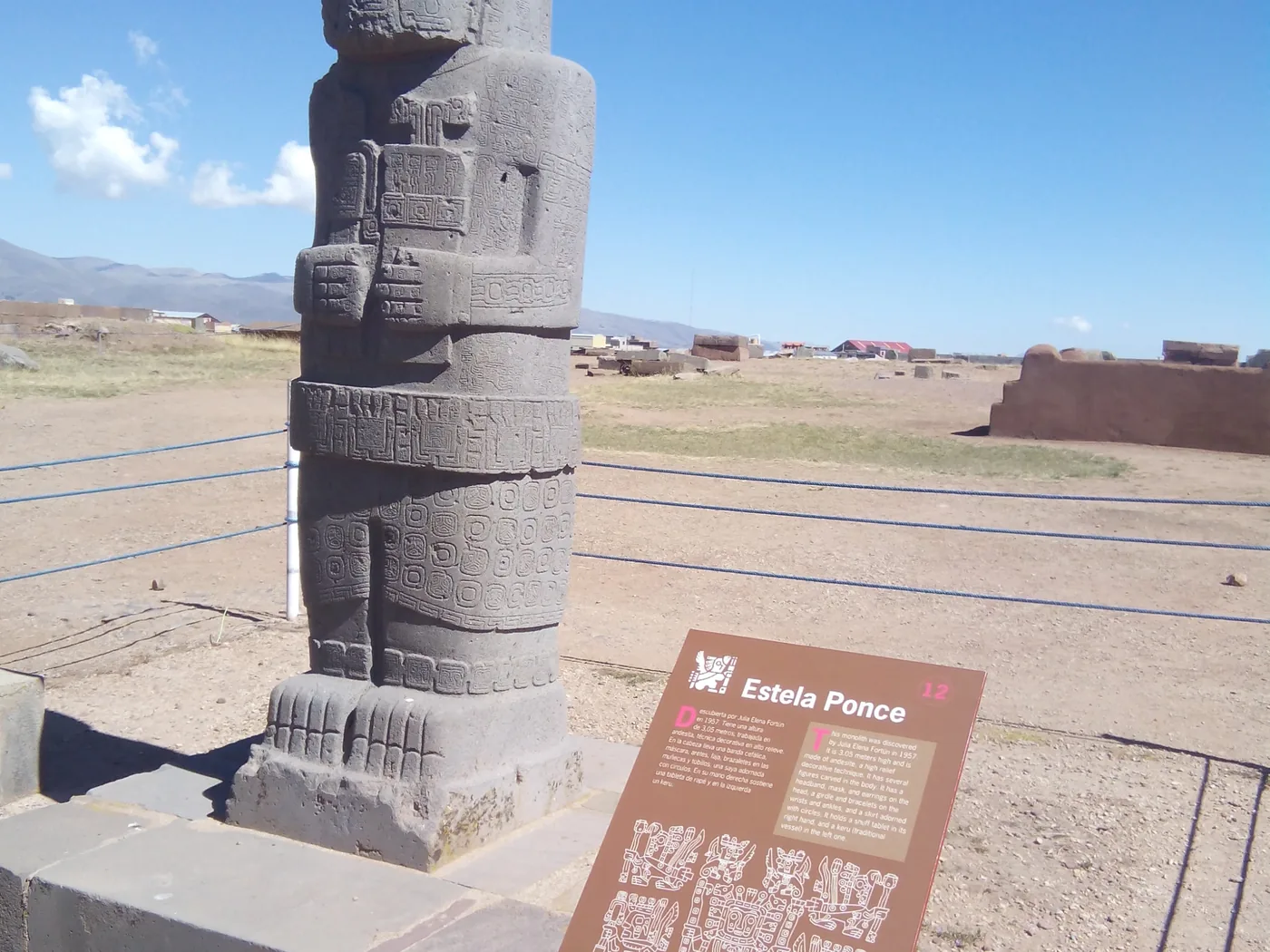
A vast walled ceremonial platform over 100 metres long, entered by a monumental stairway and aligned to the equinoxes and solstices. Within it stand the Ponce Monolith and the Gateway of the Sun — the ritual centre of the city.
- Puma Punku
The precision-cut blocks
A short walk from the main group, Puma Punku is a terraced platform scattered with the famous H-shaped blocks and colossal slabs — masonry so exact and so heavy that it remains the site's most debated and photographed feature.
- Akapana
The stepped platform
A huge terraced earth-and-stone platform, roughly 200 metres across and once crowned by a sunken court. Climb it for the clearest sense of Tiwanaku's scale and its command of the surrounding plain.
- Monoliths
The carved stone giants
Tiwanaku's monoliths — the towering Bennett Monolith (the largest stele in the Andes) and the Ponce Monolith — are carved head to foot with figures and symbols. They are among the finest sculptures of the ancient Andean world.
- The museums
Ceramic & lithic collections
Two on-site museums hold the greatest of the finds — the Bennett Monolith, ceramics, tools and carvings — and the interpretation that turns weathered stone into a legible civilisation. Most guided visits include them.
The day trip from La Paz
The day trip from La Paz
Tiwanaku sits out on the altiplano, so nearly everyone visits on a guided day trip from La Paz — here's how it works.
An easy day out of La Paz
Tiwanaku is about 70 km west of La Paz, roughly 1.5 hours' drive each way, so tours run comfortably as full or half-plus days — typically leaving La Paz in the morning and returning in the afternoon. It's one of the most rewarding day trips in Bolivia.
Guided for a reason
Tiwanaku rewards context. Much of what makes it extraordinary — the astronomy of the Kalasasaya, the engineering of Puma Punku, the meaning of the carvings — only comes alive with a guide, which is why almost all visitors come on a guided tour rather than reaching the site alone.
What tours include
Day trips generally bundle round-trip transport from La Paz, the site and museum entrance, and a guide; many include a traditional lunch, and some pair Tiwanaku with Lake Titicaca or the Valley of the Moon. Check exactly what your chosen option includes when you book.
On site & the altitude
You'll walk on open, uneven ground at around 3,850 metres, so go slowly, keep hydrated, and bring sun protection and a warm layer — the altiplano is intense in the sun and cold in the wind. If you've just arrived in Bolivia, give yourself a day or two to acclimatise first.
Tiwanaku & the altiplano, in pictures
Tiwanaku & the altiplano, in pictures
The gateways, temples, monoliths and giant blocks of Tiwanaku, high on the Bolivian altiplano.
Tour options & what's included
Tour options & what's included
| Option | What it includes | Good to know |
|---|---|---|
| Group day trip | Round-trip transport, entrance, guide, often lunch | The standard, best-value way to visit |
| Small-group / premium | Fewer travellers, more comfort, full guiding | A more relaxed take on the day |
| Private tour | Your own vehicle, guide and pace | Flexible; the priciest option |
| Tiwanaku + Titicaca | Options that add Lake Titicaca or the Valley of the Moon | More of the altiplano in one trip |
Ways to visit Tiwanaku
Find a Tiwanaku day trip for your dates
Every option below is bookable through GetYourGuide, with live availability and the final price shown in your own currency before you pay.
Planning your visit
Planning your visit
Acclimatise first
Tiwanaku sits at around 3,850 metres and La Paz is higher still, so give yourself a day or two in the highlands before you go. Take it slowly on site, drink plenty of water, and don't plan anything strenuous for the same day.
Go with a guide
Tiwanaku is spectacular once you understand what you're seeing, and easy to under-appreciate without context. A guided tour is well worth it here — the interpretation of the astronomy, the carvings and Puma Punku's engineering is a big part of the value.
Dress for the altiplano
The site is open with little shade, brilliant sun and a cold wind. Bring a hat, sunglasses and strong sunscreen, plus a warm layer and a windproof, and wear sturdy closed shoes for uneven ground.
Consider pairing it with Titicaca
Some tours combine Tiwanaku with Lake Titicaca or the Valley of the Moon. If you want to see more of the altiplano in one trip, it's an efficient way to do it — just expect a longer day.
Booking flexibility
The listings offer free cancellation up to 24 hours before and, on many options, reserve-now-pay-later — so you can lock in a departure without paying today and still adjust if your La Paz plans change.
Planning a Tiwanaku day from La Paz
Planning a Tiwanaku day from La Paz
GEO/FAQ
Tiwanaku day-trip questions
What is Tiwanaku?
Tiwanaku (also spelled Tiahuanaco) is an archaeological site on the Bolivian altiplano near Lake Titicaca, and the capital of the pre-Inca Tiwanaku civilisation. Founded around AD 110, it grew to its height between about AD 375 and 700 before collapsing around AD 1000. Its monuments — the Gateway of the Sun, the Kalasasaya temple, the Akapana platform, the carved monoliths and the precision-cut blocks of Puma Punku — have been a UNESCO World Heritage Site since 2000.
How do I get there from La Paz?
Tiwanaku is about 70 km west of La Paz — roughly 1.5 hours' drive each way. There's no easy tourist-friendly public route, so almost everyone visits on a guided day trip from La Paz. Tours typically leave in the morning and return in the afternoon.
Is it worth the day trip?
If you're interested in ancient history, yes: Tiwanaku is one of the most important pre-Inca sites in South America, and Puma Punku's stonework is genuinely astonishing. Because much of the meaning is in the astronomy, carvings and engineering, a knowledgeable guide makes a big difference — which is why guided day trips are the norm.
What will I see there?
The highlights are the Gateway of the Sun, the raised Kalasasaya court with its monoliths, the Akapana platform, and Puma Punku with its famous precision-cut blocks. Two on-site museums hold the greatest finds, including the towering Bennett Monolith. The vast altiplano setting near Lake Titicaca is striking in itself.
How should I handle the altitude?
Tiwanaku is at around 3,850 metres, so acclimatise for a day or two in the highlands first, move slowly on site, drink plenty of water, and bring sun protection and a warm layer for the strong sun and cold wind. Anyone with altitude concerns should check with a doctor before travelling to the Bolivian highlands.
Can I combine Tiwanaku with other sites?
Yes — some day trips pair Tiwanaku with Lake Titicaca or the Valley of the Moon, giving more of the altiplano in one outing. Each option's inclusions and live price are shown in the booking widget, and the listings offer free cancellation up to 24 hours before.
Still deciding which Tiwanaku tour, or which day?
Leave your email and roughly when you're travelling — we'll send a short rundown of how the Tiwanaku day trips from La Paz compare, what's included, and how to plan for the altitude.